
Harvesting your hay crop is all about timing, moisture control and efficient field operations during hay season. Whether you're new to making hay or you're refining your hay production process, the goal of hay harvesting is the same: cut forage at peak nutritional value, dry it quickly and bale it before aging, weather and moisture cause spoilage and lost nutritional value.
This complete guide to hay harvest covers how timely haying, effective baling and wrapped bales can contribute to and preserve the nutritional value of your hay crops, whether you're running a small farm operation or a larger hay farming business.
Harvest Hay at Peak Maturity
Hay should be harvested as soon as the plants reach their peak maturity. Cutting too late:
- Increases fiber, which decreases digestibility. Digestibility drops each day during the first several days after peak maturity.
- Sugars decline as plants shift their energy to seedheads. Energy levels can drop by 5% to 10% in a week.
- A 3- to 7-day delay can reduce hay quality by an entire grade.
Grasses (such as orchard grass, timothy and tall fescue) should be cut at the late boot stage when the seed head is just emerging. The field still looks dense and leafy, green throughout, with no visible seed heads. That’s peak quality. Orchardgrass loses roughly half a percent of digestibility per day once it moves past this point, so the window is shorter than it feels.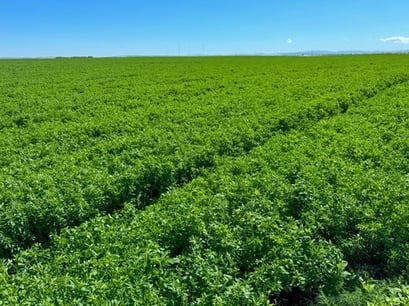 Legume hays (such as alfalfa, clover and perennial peanut) are highly palatable, nutrient-dense forages rich in protein, calories and calcium. They should be cut at early bloom stage. A field at full bloom looks noticeably purple from the cab. More flowers mean more yield and less protein.
In an alfalfa-orchardgrass mix, aim to cut when alfalfa is at late bud and orchardgrass is in boot stage; getting both to align at first cutting is easier when you’ve selected orchardgrass varieties that mature on a similar timeline as your alfalfa.
Agronomists recommend aiming for 3 to 5 days of sunny, dry, warm weather for mowing, raking and baling your hay. There’s a definite trade-off between ideal conditions and nutritional losses due to delayed mowing.
Cutting in the afternoon allows some of the plant’s natural sugars, which have been building during the day, to remain in the cut material rather than being respired overnight.
Before you cut, bend a stem. At the right stage, it’ll flex rather than snap. And look at the leaf-to-stem ratio from above. A field ready to cut looks leafy and full. A field past its window looks stemmy and open. Leaves are where the protein is; stems are fiber.
Compaction from cutting a wet field in spring shows up in regrowth for the rest of the season. If the crop is ready but the ground is soft, it’s usually worth waiting a day. A slightly early cut in a solid 5-day weather window will outperform a perfectly timed cut that gets rained on.
Mow Hay to Facilitate Drying
The mower-conditioner, whether it uses steel rollers or rubber rolls, crimps or cracks the plant’s waxy stem, allowing moisture to escape faster. Without conditioning, you’re relying on the cut ends of the stem to lose moisture, which is a slow process. A mower-conditioner can reduce
drying time by a day or more under the right conditions.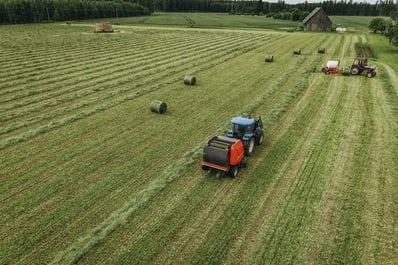 Cut between 2 and 4 inches, depending on the crop. Leaving too much stem reduces yield, but it also allows better airflow under the cut material as it dries.
A wide, spread swath dries faster than a narrow, thick one. If speed matters more than protecting the hay from traffic (wheel traffic on a wet windrow can cause leaf shatter and ash contamination), spread wide.
In humid climates or with heavy, dense cuttings, tedding is often worth doing. A tedder flips and loosens the windrow, exposing more surface area to sunlight and airflow. Ted when the hay still has enough moisture to be pliable. If you ted when it’s already dry or close to dry, you’ll knock leaves off the stems — and leaves are where the protein is. You can ted more than once if conditions are slow, but watch the moisture closely as it drops.
Rake when the hay is at roughly 30% to 40% moisture. Raking at lower moisture increases leaf shatter, particularly in legumes like alfalfa and clover. The windrow you leave behind should match what your baler handles well; too narrow and the baler labors, too wide and the crop bunches and picks up unevenly.
Wheel rakes are common and affordable, but can be harder on leaf retention in legumes. Rotary rakes tend to be gentler but cost more. The choice depends on what you’re baling and what your operation can support.
Bale Hay to Retain Nutritional Value
Bale too wet and you’re setting up problems in storage, from heat, mold and dry matter loss at minimum, to potential barn fire at worst. Bale too dry, and you lose leaves to shatter before the baler even picks the crop up.
Typically, hay is baled in:
- Round bales —
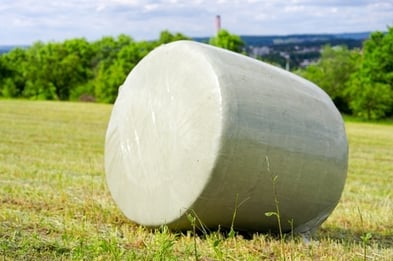 4-6 feet in diameter × 4-5 feet wide, weigh 800–2,000 pounds depending on density and moisture.
 - Small square bales — 30-40 inch length × 16-22 inch width × 14-16 inch height, typically 40-70 pounds; easy to handle manually.
- Large square bales — 7-8 feet length × 3-4 feet width × 2-4 feet height, weigh 800–1,500 pounds; requires machinery for handling.
To prevent spoilage from mold, agronomists recommend not baling hay until it has dried to 20% or less moisture:
- Small square bales should be dried to 18% to 20% moisture.
- Large square bales should be dried to 12% to 18% moisture.
- Round bales should be dried to 15% to 18% moisture.
- Hay baleage (a hybrid between traditional dry hay and silage) can be baled in wrapped round bales when dried to 45% to 60% moisture.
A moisture meter takes the guesswork out of the baling decision. The hand-squeeze test and the twist test have their place, but they're imprecise enough that they'll lead you wrong on borderline days. If you're making a significant volume of hay or your storage situation is tight, a meter pays for itself quickly.
Each bale type has its advantages and disadvantages:
| Factor | Round Bales | Square Bales |
| Labor Needed | One operator; machine handles the load | Multiple hands for stacking and hauling |
| Host Machine | Tractor or skid steer with a wrapper attachment | Small squares often move by hand, no machine required |
| Stacking in the Yard | Bulky, settles fine sitting outdoors | Stacks tightly, but needs a dry roof overhead |
| Spoilage Exposure | Outer layer takes the weather, wrap protects the core | Spoils fast once it gets wet; little weather tolerance |
| Feed Consistency | Can vary if curing or wrap quality is uneven | Steady quality when kept dry, start to finish |
| Best For | Herd feeding, pasture-side operations | Horse owners, boutique hay buyers |
| Cost per Ton | Generally lower | Generally higher |
Moisture Levels in Hay
The reason moisture levels matter so much is that they determine what happens to your hay after it's in storage, and the biology that takes over once a bale is sealed up doesn't work in your favor if conditions aren't right.
What Happens When You Bale Too Wet
When hay is baled above safe moisture levels, aerobic bacteria begin breaking down organic matter in the bale, which produces heat. Some heating is normal in the first week or two; a new bale will commonly reach 100 to 110 degrees Fahrenheit and then cool down. That's not a concern.
What you don't want is sustained elevated temperatures above 150 degrees, which indicates excessive microbial activity. At those temperatures, you're losing dry matter and the proteins in the hay are binding in ways that reduce digestibility. The caramelized appearance you sometimes see in over-heated bales reflects actual nutritional degradation. Above 150 degrees, you have a potential ignition risk.
Beyond heat, wet hay molds. Mold doesn't just reduce palatability; it also reduces the forage's energy and protein content and can introduce mycotoxins that affect animal health. Once a bale molds significantly, you can't recover it.
Hay Preservatives and Inoculants: When and Why to Use Them
Dry Hay Preservatives
Hay preservatives are applied at baling when moisture content is running higher than ideal, typically in the 18% to 25% range for dry hay. They don't make wet hay safe to bale at any moisture level; they extend the safe range modestly. This means that when a weather window closes faster than expected, you're not stuck watching a field of cut hay sit in the rain.
The most commonly used hay preservatives are organic acids. Propionic acid is the standard dry hay preservative. It’s effective at inhibiting the mold and bacterial growth that cause heating and dry matter loss. It's applied through a system mounted on the baler that treats the crop as it's packed.
One important handling note: propionic acid is caustic. It can damage equipment over time and will harm skin and eyes. Most producers use a buffered version (ammonium propionate, sometimes labeled as "neutralized" or "pH balanced" propionic acid), which is less corrosive and easier on equipment and the people using it. The buffered version is somewhat less effective than straight propionic acid at high moisture levels, but it's the more practical option for most operations.
Application rates vary based on moisture and bale size. For small square bales with 20% to 25% moisture, a 0.5% to 1.0% propionic acid solution is typical. Bales running 25% to 30% moisture require 1.0% to 1.5%. For large round bales, propionic acid preservatives have shown limited effectiveness, and plastic wrapping is generally the more reliable option at higher moisture levels.
Preservatives have shown inconsistent results at moisture levels above 30%. At that point, the better answer is to wait for better conditions, accept the yield hit and cut the crop later, or wrap the bales.
Hay Inoculants for Baleage and Wrapped Hay
Hay inoculants are a different product for a different purpose. They're designed for baleage (high-moisture forage that's wrapped in plastic rather than dried), and their job is to support rapid, controlled fermentation.
When baleage is wrapped properly at 40% to 60% moisture and sealed from air, naturally occurring and introduced bacteria produce lactic acid and other acids — otherwise known as fermentation. Fermentation drops the pH of the bale and preserves the forage. Hay inoculants introduce beneficial bacteria to give the process a head start and reduce the window during which harmful microbes can establish.
There are two broad categories of bacterial inoculants:
- Homofermentative inoculants produce lactic acid as their primary output. Lactic acid is a weaker spoilage inhibitor but is efficient at preserving nutritive value. To maintain the forage's feed quality, this is the type to use.
- Heterofermentative inoculants produce a mix of lactic acid, acetic acid and ethanol. Acetic acid is a stronger spoilage inhibitor, which means these inoculants are better at reducing bale heating and extending aerobic stability once a bale is opened. The tradeoff is slightly more dry matter loss during fermentation.
The rule of thumb: Homofermentative inoculants preserve nutritive value, while heterofermentative inoculants reduce bale heating. A third category combines both types, and combination products are increasingly common.
One thing inoculants can't do is improve forage that wasn't worth much to begin with. The fermentation process doesn't add nutritive value; it protects what's there.
Inoculants should be applied uniformly as the crop is baled, ideally to the windrow, and before any rain event. They also don't have a long shelf life once opened, so follow storage and use instructions carefully.
What About Hay Desiccants?
Desiccants sometimes get lumped in with preservatives, but they're used differently. A desiccant is applied at cutting to speed the field-drying process; it works on the plant before baling. A preservative is applied at baling to protect hay that's going into storage at marginal moisture. Different tools, different timing, different problems solved.
.jpg?width=579&height=389&name=GX010387(1).jpg)
Wrapping Round Bales Helps Preserve Feed Quality
Bale wrapping offers major advantages for hay producers in climates where drying windows are short. It protects forage from weather, reduces spoilage, preserves nutrients and allows baling at higher moisture content — making it one of the most reliable ways to secure high-quality feed.
Bale wrapping:
Preserves Nutritional Quality — Wrapped bales undergo anaerobic fermentation, converting plant sugars into organic acids that stabilize the forage and improve digestibility, providing:
- Higher protein retention
- Better feed energy value
- Reduced leaf loss compared to dry hay
Provides Weather Protection and Reduced Spoilage — Silage wrap completely seals the bale, protecting it from rain, snow and moisture damage. It:
- Prevents mold growth
- Reduces nutrient leaching
- Allows storage outside for months without quality loss
- Minimizes waste, as dry hay left uncovered can lose 15% to 50% of its feed value in 3-6 months
Allows Greater Harvest Flexibility — Baleage can be baled at 45% to 60% moisture, avoiding long drying times. This means:
- You can harvest in shorter weather windows
- Less risk of rain damage
- You can cut at peak nutritional value, providing higher forage quality
- More consistent harvest scheduling
Improves Feed Efficiency — Wrapped forage:
- Has higher digestibility
- Produces less sorting and waste at the feeder
- Supports better weight gain and milk production
- Can be fed year-round with minimal loss
Has Operational and Storage Advantages — Wrapping bales:
- Eliminates the need for barn storage. The bales can sit in the field or along fence lines
- Makes them easier to transport without losing material
- Reduces upfront cost
Supports Sustainable Farming — Bale wrapping reduces forage waste so that fewer acres are needed to produce the same nutritional value, reducing labor and feed spoilage.
The Halverson HWP-Bale Wrapper: Do More With Less
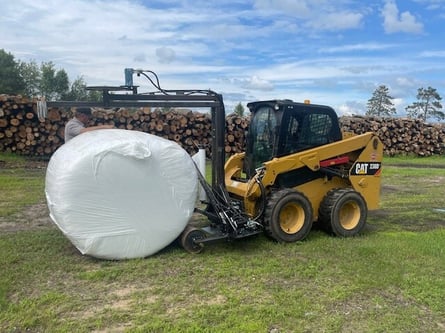
Halverson's HWP-Bale Wrapper attachment connects to the tractor or skid steer you're already running. One person handles the full wrapping operation from the cab, lifting, spinning and wrapping without getting off the machine. That means faster turnaround between bales and less exposure to the elements during a season when the weather is rarely cooperating. It’s specifically designed to help smaller farm and ranch operators get the most from their hay crops.
Quick Attach: Using the Universal Quick Attach system (a wedge and latch system to secure attachments), the HWP-Bale Wrapper can be picked up and securely attached to your skid steer in a matter of minutes. Just lock the latches on the quick-attach plate, attach the two quick-connect hoses and the power plug, and you’re ready to start wrapping your bales.
Less Than 2 Minutes per Bale: A skilled single operator can apply 4-6 layers of plastic wrap on a standard 4- or 5-foot round bale in less than 2 minutes. Just push the bale ahead and wrap to your desired quality.
All the Benefits of Bale Wrapping Without the Big Investment: Priced under $5,300 MSRP, the HWP-Bale Wrapper helps you experience the advantages of wrapped round bales without a large equipment investment.
One Person, One Machine: One person can wrap more hay in less time from the comfort and safety of the skid steer's cab. No heavy lifting or helpers needed.
If you're already running a compatible host machine, it's worth a conversation with a Halverson dealer to see how you can do more in less time with less labor.
Check out the HWP-Bale Wrapper or talk with a Halverson expert at 218-587-2865.
Storing Hay So It Lasts
Barn storage is the best option when you have it. Protecting hay from UV, precipitation and ground moisture preserves dry matter and prevents the outer layer losses that are inevitable in outdoor storage. A well-stored bale in a barn can look nearly identical 6 months later; the same bale stored outside on bare ground in the open often loses 20% to 30% of its dry matter over a winter.
When outdoor storage is the only option:
- Get bales off bare ground. A gravel pad, crushed stone or even a row of pallets reduces ground contact moisture absorption significantly.
- Orient round bales north-to-south so the sun hits both sides through the day, which keeps the outer layer drier.
- Leave space between rows for airflow. Bales stored touching each other trap moisture at contact points.
- Cover with tarps or net wrap if the storage period extends beyond a few months.
- If possible, opt for large round bales, as they shed weather better than small squares.
Check bales in the first 3-4 weeks of storage, particularly if you pushed the moisture threshold at baling. Some warmth in a new bale is normal. A bale that's still running hot after 3 weeks is telling you something went wrong at baling.
One Person Can Do This — With the Right Equipment
 Hay production doesn't lend itself to shortcuts. The window between "ready to cut" and "quality starts dropping" is short, and the weather doesn't adjust its schedule for yours. The difference between hay that carries your livestock through winter in good condition and hay that disappoints comes down to quick decisions made in the field, and the right hay harvesting equipment to back them up.
But if you're looking at the bale-wrapping side of your operation and thinking there's a better way to handle it with what you already own, reach out to the Halverson sales team. They can show you how the HWP-Bale Wrapper attachment works with your existing skid steer, tractor, front loader or excavator to do more work in less time with less manpower.